💨 Rehabilitating a Station, Rethinking Air: Ten Years of Integrated Engineering at Saint-Michel Notre-Dame
In 2016, the Saint-Michel Notre-Dame station (RER C) entered a major rehabilitation project.
Very early on, a significant challenge emerged: the station was identified as one of the most exposed to fine particulate matter1 — namely PM10 and PM2.5 — within the underground network.
SNCF Gares & Connexions therefore asked AREP to provide a scientific and operational perspective on this issue, with the objective of exploring all credible avenues of action.
This marked the beginning of a nearly ten-year journey combining research, engineering, architecture, and innovation.
Early Investigations: Ventilation, Filtration… and Their Limits
From the very first studies, AREP’s engineering teams explored conventional technical solutions together with the HVAC team2. Two approaches were investigated in parallel:
Replacing smoke extraction fans with dual-mode systems, capable of providing both fire safety and comfort ventilation. However, spatial constraints and acoustic limitations made this option impractical.
Installing air filtration units on the platforms, co-developed with an industrial partner. Here again, the available volumes and functional constraints prevented achieving sufficient performance.
Although ultimately abandoned, these investigations played a crucial role: they showed that technical solutions alone would not be sufficient. A deeper understanding of the physical processes governing air quality in the station was required.
Building a Scientific Understanding: An Incremental Research Approach
In parallel with the HVAC studies, L’Hypercube gained access to and analyzed the extensive air quality datasets already collected by SNCF. It quickly became clear that no existing tool could adequately explain the dynamics of particulate matter in an underground station.
The L’Hypercube team therefore decided to develop its own modelling framework.
A first PM10 model was developed to link railway traffic, ventilation, deposition processes and measured concentrations ( publication ).
A second, more comprehensive model distinguished two particle size classes (PM10 and PM2.5), allowing a finer understanding of the differing behaviour of coarse and fine particles ( publication ).
These scientifically validated models progressively became operational exploration tools for the project’s engineering teams.
A Key Missing Parameter: How Much Air Do Trains Really Move?
The models highlighted a fundamental phenomenon: the piston effect — the renewal of air induced by trains entering and leaving the station.
However, its actual magnitude at Saint-Michel Notre-Dame remained unknown.
To address this, AREP partnered with CSTB3 to develop a CFD simulation framework capable of dynamically modelling the passage of a train. On-site anemometric measurements were then used to validate the simulations.
Both steps were presented at the OpenFOAM 2018 conference (
publication
).
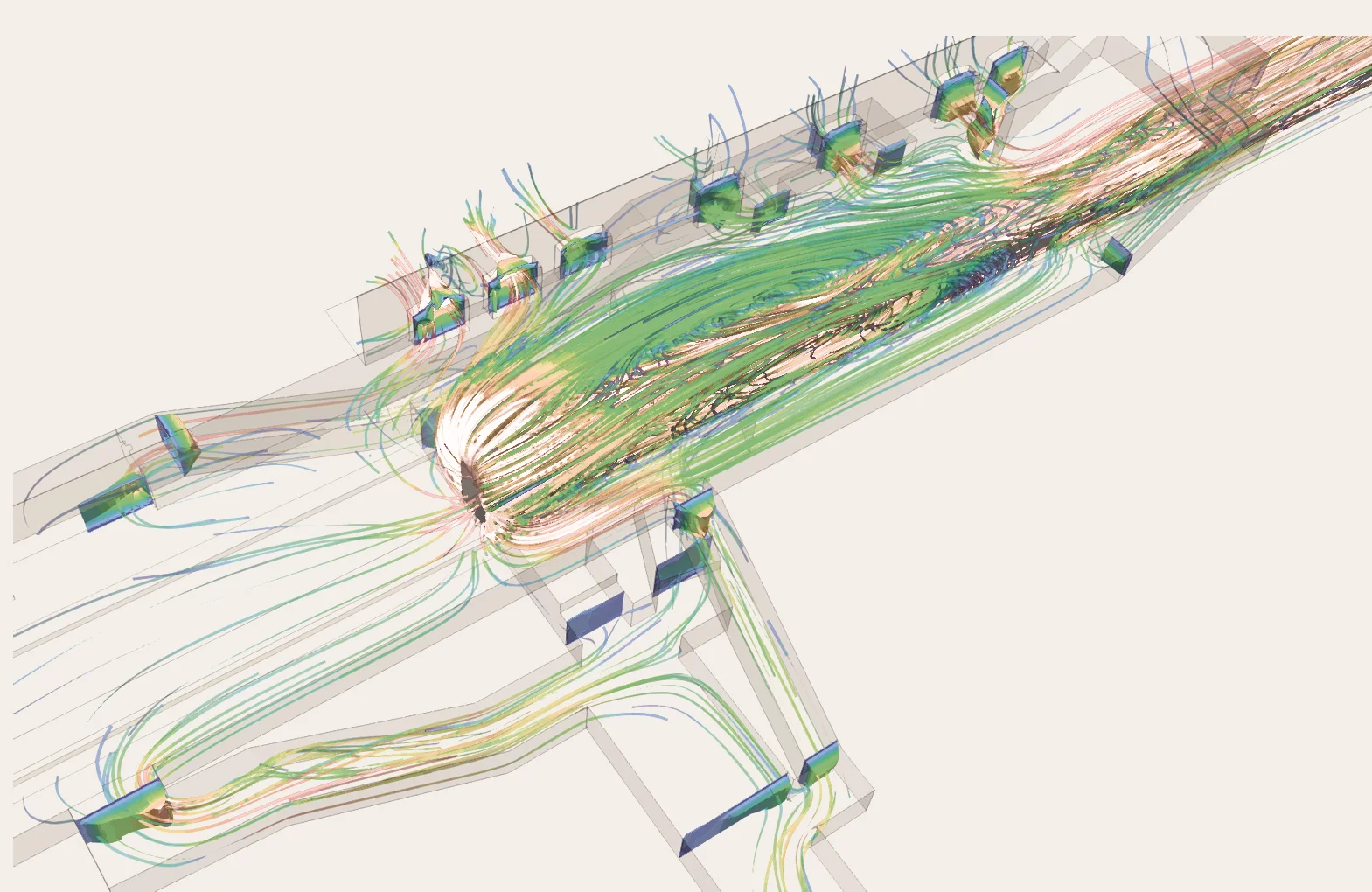
For the first time, it became possible to accurately quantify the air flow rates passing through the station’s openings.
When Science Opens an Architectural Path: Reopening the Seine-Facing Bays
Historically, the station featured around a dozen bays opening onto the Seine riverbanks. These had been sealed in the 1970s following flood events.
AREP’s architects then formulated an intuition:
What if these bays were reopened to let the station breathe again?
Thanks to the equation-based models and CFD simulations, this scenario could be tested quantitatively.
The results were striking: fully reopening the bays would lead to an improvement in air quality of nearly 75%.
Research was no longer just an analytical tool — it had become a driver for design decisions.
An Iterative Process Combining Architecture, Acoustics, Hydraulics and R&D
During the detailed design phase, two major constraints emerged:
- noise: a fully open configuration would be incompatible with nearby residential areas along the Seine;
- flood protection: the station needed to remain safe during a centennial flood event.
Architects, HVAC engineers, acousticians, hydraulic engineers and researchers worked in short iterative loops, testing multiple configurations. At each step, L’Hypercube evaluated the impact on air quality, enabling informed trade-offs between environmental performance and operational constraints.

Eventually, an innovative solution emerged: inclined glazing systems that block floodwater, reduce noise transmission, and allow air circulation through their upper section.
This configuration resulted in an improvement of approximately 48% in fine particulate concentrations, while complying with acoustic regulations and ensuring protection against flooding.
Recognition and Validation
In 2021, the project was awarded the French National Engineering Prize (Syntec) ( blog post ), recognising the integrated approach and the strong link between research and architecture.
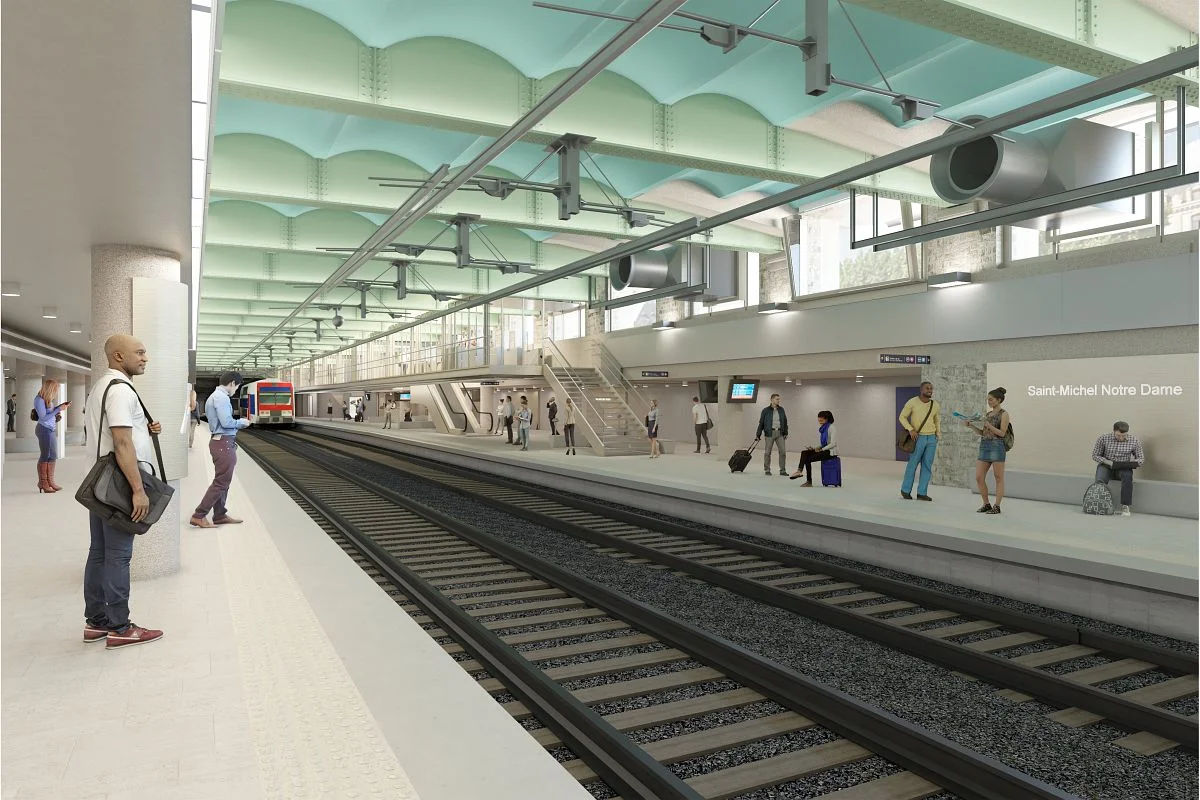
The rehabilitated station was inaugurated in 2023. In 2025, a new measurement campaign indicated an improvement of around 50% in fine particulate concentrations (average PM10 and PM2.5) compared with 2019 (results still to be consolidated).
Conclusion – A Decade of Integrated Innovation
The story of Saint-Michel Notre-Dame shows that improving air quality in underground stations cannot rely on a single technical fix or on disconnected theoretical models.
Instead, it emerges from a continuous dialogue between research, engineering, architecture and operations. The early HVAC studies, the models developed by L’Hypercube, CFD simulations, acoustic and hydraulic trade-offs, and post-construction measurements all form part of a single trajectory.
In a field where phenomena are complex and constraints numerous, this progressive and integrated approach made it possible to maintain a coherent thread between research, design and operation, ultimately delivering measurable improvements in air quality while revealing the full architectural potential of the site.
airborne particles with an aerodynamic diameter smaller than 10 and 2.5 µm respectively. Learn more ↩︎
HVAC: Heating, Ventilation and Air Conditioning ↩︎
CSTB: Scientific and Technical Centre for Building ↩︎