 L'hypercube
IBPSA France 2026
L’hypercube was present at the IBPSA France 2026 conference — in Lyon, from May 18 to 22, 2026 — to present work on thermo-hydrological modelling of urban ground surface temperatures, and on the design of bio-analogous climate shelters as part of the AbriCoCoDA project.
All proceedings are available on the IBPSA France website.
Note: both publications below are in French.
Thermo-hydrological modelling of ground surface temperatures
Information
- Title : Modèle thermo-hydrique pour la simulation des températures de surface de sol en environnement urbain
- Authors : Édouard WALTHER, Mateusz BOGDAN, Guilhem COTTET
- Access : Link to article
BibTeX
@inproceedings{walther2026soltemp,
  title     = {Mod{\`e}le thermo-hydrique pour la simulation des temp{\'e}ratures de surface de sol en environnement urbain},
  author    = {Walther, {\'E}douard and Bogdan, Mateusz and Cottet, Guilhem},
  booktitle = {IBPSA France 2026},
  year      = {2026},
  address   = {Lyon, France}
}
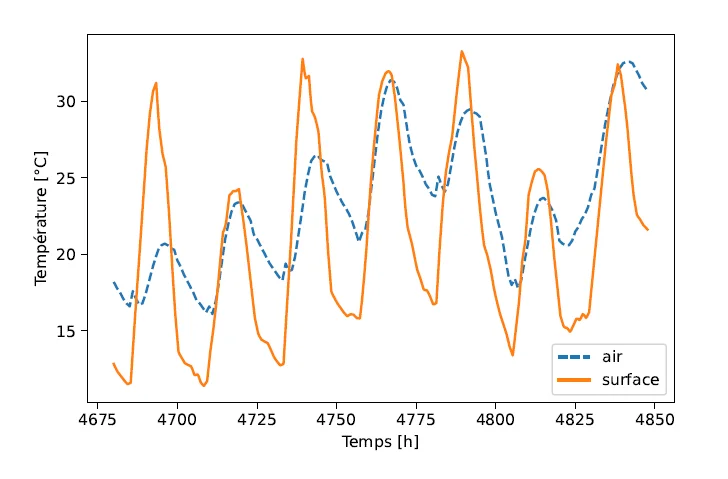
This work proposes an improvement to the ground model of the ICE-Tool QGIS plugin, an urban design tool for rapid estimation of surface temperatures based on layout choices. Two 1D models are introduced: a variable-step implicit numerical scheme for the transient heat equation, and a hydrological model based on Richards’ equation to represent moisture dynamics in permeable soils.
Designing climate shelters with performance comparable to continuous tree canopies — AbriCoCoDA project
As part of the co-supervision of the AbriCoCoDA post-doctoral project more info , L’hypercube contributed to this study on the quantitative design of high-performance urban shelters.
Information
- Title : Comment concevoir des abris avec des performances climatiques similaires aux couverts arborés continus ?
- Authors : Teddy GRESSE, Damien DAVID, Frédéric LEFEVRE, Mathieu GALTIER, Mateusz BOGDAN, Marjorie SALLES, Estelle MORLÉ, Karine LAPRAY
- Access : Link to article
BibTeX
@inproceedings{gresse2026abris,
  title     = {Comment concevoir des abris avec des performances climatiques similaires aux couverts arbor{\'e}s continus~?},
  author    = {Gresse, Teddy and David, Damien and Lefevre, Fr{\'e}d{\'e}ric and Galtier, Mathieu and Bogdan, Mateusz and Salles, Marjorie and Morl{\'e}, Estelle and Lapray, Karine},
  booktitle = {IBPSA France 2026},
  year      = {2026},
  address   = {Lyon, France}
}
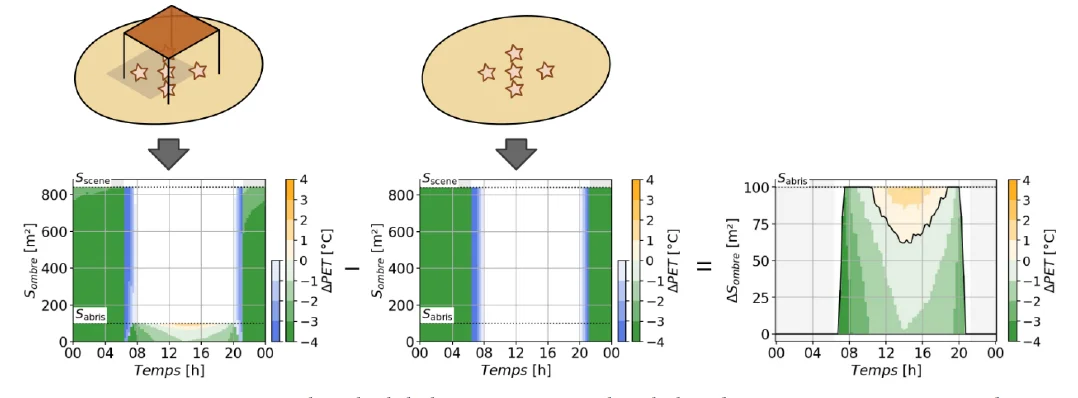
The paper proposes a quantitative methodology for evaluating urban climate shelters, based on the AbriCoCoDA criterion: a shelter performs well if the PET index at pedestrian height is lower than or equal to that measured under a continuous tree canopy. Simulations are conducted with the thermo-radiative model IMOTEP for a typical future hot summer day in Lyon (2040–2060 horizon). Three major design rules emerge: a size greater than 5 m, the exclusion of lightweight fabrics in favour of insulated and thermally inert structures, and a preferred placement north of a south-facing building, without overlapping its shadow.